
- News
- Elections News
- Assembly Elections News
- Bihar News
- Bihar assembly elections: Why JD(U) and LJP couldn't be in the same alliance
This story is from October 6, 2020
Bihar assembly elections: Why JD(U) and LJP couldn't be in the same alliance
The LJP’s move to contest against Nitish Kumar’s JD(U), but to remain a part of the NDA at the Centre, could be a well thought out ploy to keep options open for realignment within the state alliance if the BJP performs better than the JD(U).
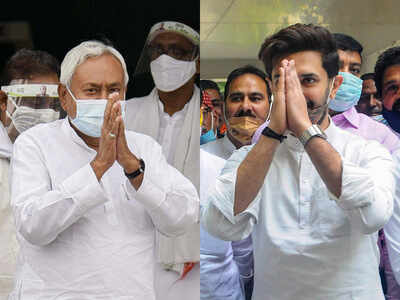
File photo of Nitish Kumar (L) and Chirag Paswan
NEW DELHI: Chiraj Paswan-led Lok Janshakti Party’s decision to walk out of the National Democratic Alliance in Bihar has added a new twist to the upcoming assembly elections in the state.
The LJP’s move to contest against Nitish Kumar’s JD(U), but to remain a part of the NDA at the Centre, could be a well thought out ploy to keep options open for realignment within the state alliance if the BJP performs better than the JD(U).
The ruling NDA in Bihar seems to be on a strong wicket for the 2020 electoral battle. The coming together of the BJP and the JD(U) has made the alliance formidable. But with the JD(U) versus LJP battle on, the stage may have been set for an interesting finish to these polls.
LJP and JD(U) as political opponents
Before the LJP walked out, the NDA in Bihar was a unique combination where the two dominant partners, the BJP and the JD(U), were together, but they had satellite allies. While the LJP was with the BJP, Nitish Kumar’s JD(U) has tied up with
Now, the LJP has parted ways with the JD(U) but has not ended its association with the BJP. This may give the BJP an edge over the JD(U) as it is an open secret that the two dominant partners are also locked in a keen tussle to emerge as the single largest party in the alliance.
2015 assembly elections
In 2015, the BJP and the JD(U) were on the opposite sides of the political divide. The BJP got 24.42 percent of the votes, while the JD(U) managed 16.83 percent vote share. Together these two dominant partners got a little over 41 percent votes and are firmly together in the alliance.
The Lok Janshakti Party (LJP), which was the third key partner of this group, is now out of the alliance. The LJP has announced that it will contest against the JD(U), but will not field candidates against the BJP. Chirag Paswan’s party won only 2 seats in 2015 elections, but managed a vote share of 4.83 percent.
LJP vs JD(U) in 2015 elections
In the 2015 elections, the LJP came second on 36 assembly seats. Of these 36, it was in direct contest with the JD(U) in 22 seats. Though it could manage to win only one of these 22 seats, it is unlikely to leave its claim on the remaining 21. The JD(U)’s victory margin on 4 seats was less than 5 percent, while on another 5 seats it was between 5 and 10 percent. In the remaining 12 seats, the JD(U)’s victory margin was over 10 percent.
2010 assembly elections: LJP vs JD(U)
If we analyse the 2010 assembly elections which the LJP and the JD(U) again fought as opponents, we see that the two were the main contestants in 28 seats. The JD(U) won 27 of these seats. In 19 of them it managed a comprehensive win with a margin of over 10 per cent. In 5 seats, the JD(U)’s victory margin was between 5 and 10 percent and in 3 assembly seats it was less than 5 percent.
Thus, we see that the JD(U) has been way ahead of the LJP in the assembly elections.
LJP and JD(U) in Lok Sabha elections
Now, let’s analyze their performance in the last two Lok Sabha elections.
The LJP and the JD(U) fought the 2014 Lok Sabha elections as opponents. While the LJP was a part of the BJP-led NDA, Nitish Kumar had walked out of the alliance opposing the projection of Narendra Modi as the PM candidate. The LJP contested 7 Lok Sabha seats and won 6 of them with a vote share of 6.5 percent. The JD(U) on the other hand was routed, winning only 2 seats though it managed a much larger vote share of 16.04 percent.
In the 2019 Lok Sabha elections, the JD(U) was back in the NDA fold and the BJP managed a truce between Nitish Kumar-led party and the LJP. An analysis of the results show that both the parties gained from the BJP alliance. While the JD(U), which contested on 17 seats, won 16 of them, the LJP contested on 6 seats and won all of them. The JD(U)’s vote share jumped to 22.26 percent and the LJP increased its vote share to 8.02 percent. Also, with JD(U) on its side, the LJP managed to increase its votes significantly on the seats it won.
JD(U) vs LJP: BJP’s challenge or BJP’s gain?
The LJP seems to have played a gamble to try and improve its dwindling electoral performance in the state especially in the assembly elections. The LJP’s best result in the state was in February 2005 assembly elections when it won 29 seats with a vote share of 12.62 percent. Since then it has been on the decline. In fact, in the next assembly elections that were held just 8 months later, it could manage to win only 10 seats.
The JD(U) on the other hand has done well consistently in the state elections winning 55, 88, 115 and 71 seats in the last 4 assembly elections. The performance gap between the LJP and the JD(U) is too large for Chirag Paswan to emerge as a real threat to Nitish Kumar.
But, the young LJP leader strongly feels that there is a strong anti-incumbency factor against Nitish Kumar and he hopes to capitalise on this to improve his party’s performance.
Chirag Paswan also knows that his party’s best performance has been in alliance. So while keeping the JD(U) out, he wants to project the BJP as his alliance partner in the state. And that explains why he is talking about a BJP-LJP government post elections to convince the voters.
Nitish Kumar would want the BJP to strongly deny Chirag Paswan’s claims, so as to ensure there is no confusion amongst the voters about BJP’s stand. It may also want the BJP to eject the LJP from the NDA. But that is unlikely to happen. The BJP would be happy keeping Nitish Kumar guessing.
The Jitan Ram Manjhi factor
The turn of events may not have come as a surprise for Nitish Kumar. In fact, his decision to join hands with his friend-turned-foe, Jitan Ram Manjhi was possibly a part of his strategy to counter this expected aggression of the LJP.
In the 2015 assembly elections, HAM(S) won just one seat, but got 2.56 percent of the vote share. However, the party can play a spoilsport for the LJP as the two parties have an overlapping support base. Nitsh Kumar hopes to use Jitan Ram Manjhi to cut into the LJP votes.
However, if the LJP does manage to perform well in these elections it may help BJP checkmate JD(U) in any post poll arrangement.
But, there is also a possibility that LJP's move may end up benefitting the opposition RJD-Congress combine if there is a three-way division of votes.
The LJP’s move to contest against Nitish Kumar’s JD(U), but to remain a part of the NDA at the Centre, could be a well thought out ploy to keep options open for realignment within the state alliance if the BJP performs better than the JD(U).
The ruling NDA in Bihar seems to be on a strong wicket for the 2020 electoral battle. The coming together of the BJP and the JD(U) has made the alliance formidable. But with the JD(U) versus LJP battle on, the stage may have been set for an interesting finish to these polls.
LJP and JD(U) as political opponents
The LJP and the JD(U) have been political opponents in the last two assembly elections and also in the 2014 Lok Sabha elections. Hence, it was naturally difficult for the two parties to strike a balance between their contesting claims for seats.
Before the LJP walked out, the NDA in Bihar was a unique combination where the two dominant partners, the BJP and the JD(U), were together, but they had satellite allies. While the LJP was with the BJP, Nitish Kumar’s JD(U) has tied up with
Jitan Ram Manjhi’s Hindustani Awam Morcha (Secular).
Now, the LJP has parted ways with the JD(U) but has not ended its association with the BJP. This may give the BJP an edge over the JD(U) as it is an open secret that the two dominant partners are also locked in a keen tussle to emerge as the single largest party in the alliance.
2015 assembly elections
In 2015, the BJP and the JD(U) were on the opposite sides of the political divide. The BJP got 24.42 percent of the votes, while the JD(U) managed 16.83 percent vote share. Together these two dominant partners got a little over 41 percent votes and are firmly together in the alliance.
The Lok Janshakti Party (LJP), which was the third key partner of this group, is now out of the alliance. The LJP has announced that it will contest against the JD(U), but will not field candidates against the BJP. Chirag Paswan’s party won only 2 seats in 2015 elections, but managed a vote share of 4.83 percent.
LJP vs JD(U) in 2015 elections
In the 2015 elections, the LJP came second on 36 assembly seats. Of these 36, it was in direct contest with the JD(U) in 22 seats. Though it could manage to win only one of these 22 seats, it is unlikely to leave its claim on the remaining 21. The JD(U)’s victory margin on 4 seats was less than 5 percent, while on another 5 seats it was between 5 and 10 percent. In the remaining 12 seats, the JD(U)’s victory margin was over 10 percent.
2010 assembly elections: LJP vs JD(U)
If we analyse the 2010 assembly elections which the LJP and the JD(U) again fought as opponents, we see that the two were the main contestants in 28 seats. The JD(U) won 27 of these seats. In 19 of them it managed a comprehensive win with a margin of over 10 per cent. In 5 seats, the JD(U)’s victory margin was between 5 and 10 percent and in 3 assembly seats it was less than 5 percent.
Thus, we see that the JD(U) has been way ahead of the LJP in the assembly elections.
LJP and JD(U) in Lok Sabha elections
Now, let’s analyze their performance in the last two Lok Sabha elections.
The LJP and the JD(U) fought the 2014 Lok Sabha elections as opponents. While the LJP was a part of the BJP-led NDA, Nitish Kumar had walked out of the alliance opposing the projection of Narendra Modi as the PM candidate. The LJP contested 7 Lok Sabha seats and won 6 of them with a vote share of 6.5 percent. The JD(U) on the other hand was routed, winning only 2 seats though it managed a much larger vote share of 16.04 percent.
In the 2019 Lok Sabha elections, the JD(U) was back in the NDA fold and the BJP managed a truce between Nitish Kumar-led party and the LJP. An analysis of the results show that both the parties gained from the BJP alliance. While the JD(U), which contested on 17 seats, won 16 of them, the LJP contested on 6 seats and won all of them. The JD(U)’s vote share jumped to 22.26 percent and the LJP increased its vote share to 8.02 percent. Also, with JD(U) on its side, the LJP managed to increase its votes significantly on the seats it won.
JD(U) vs LJP: BJP’s challenge or BJP’s gain?
The LJP seems to have played a gamble to try and improve its dwindling electoral performance in the state especially in the assembly elections. The LJP’s best result in the state was in February 2005 assembly elections when it won 29 seats with a vote share of 12.62 percent. Since then it has been on the decline. In fact, in the next assembly elections that were held just 8 months later, it could manage to win only 10 seats.
The JD(U) on the other hand has done well consistently in the state elections winning 55, 88, 115 and 71 seats in the last 4 assembly elections. The performance gap between the LJP and the JD(U) is too large for Chirag Paswan to emerge as a real threat to Nitish Kumar.
But, the young LJP leader strongly feels that there is a strong anti-incumbency factor against Nitish Kumar and he hopes to capitalise on this to improve his party’s performance.
Chirag Paswan also knows that his party’s best performance has been in alliance. So while keeping the JD(U) out, he wants to project the BJP as his alliance partner in the state. And that explains why he is talking about a BJP-LJP government post elections to convince the voters.
Nitish Kumar would want the BJP to strongly deny Chirag Paswan’s claims, so as to ensure there is no confusion amongst the voters about BJP’s stand. It may also want the BJP to eject the LJP from the NDA. But that is unlikely to happen. The BJP would be happy keeping Nitish Kumar guessing.
The Jitan Ram Manjhi factor
The turn of events may not have come as a surprise for Nitish Kumar. In fact, his decision to join hands with his friend-turned-foe, Jitan Ram Manjhi was possibly a part of his strategy to counter this expected aggression of the LJP.
In the 2015 assembly elections, HAM(S) won just one seat, but got 2.56 percent of the vote share. However, the party can play a spoilsport for the LJP as the two parties have an overlapping support base. Nitsh Kumar hopes to use Jitan Ram Manjhi to cut into the LJP votes.
However, if the LJP does manage to perform well in these elections it may help BJP checkmate JD(U) in any post poll arrangement.
But, there is also a possibility that LJP's move may end up benefitting the opposition RJD-Congress combine if there is a three-way division of votes.
End of Article
FOLLOW US ON SOCIAL MEDIA
Hot Picks
TOP TRENDING
Trending Stories
In Section
Entire Website
- Ajit's NCP slams RSS mag for questioning its entry into NDA
- Taking 'break' for medical reasons: TMC's Abhishek
- MP Akhilesh Yadav quits Karhal assembly seat
- Andhra, Odisha will usher in record development: PM Modi
- Wayanad or Rae Bareli, which to quit? My call will make people at both seats happy: Rahul
- Modi cabinet 3.0: 39% ministers have criminal cases against them
- Congress slams PM Modi over Parliamentary Affairs minister pick
- 'Dissatisfied souls': Sanjay Raut on Naidu & Nitish after portfolio allocation in Modi cabinet 3.0
- Modi cabinet 3.0: Amit Shah takes charge as Union home minister
- 'Taking responsibility of defeat': AIUDF general secretary Aminul Islam resigns as party loses LS polls
- 'Was warned in jail I would not be allowed to meet family again', Kejriwal attacks BJP's 'cruelty'
- Watch: India, Pakistan players involved in heated exchange
- No driver, no haggling, Mumbai’s BKC aims for friendliest taxi service
- 'PR stunt ... gimmick': How BJP, Cong reacted to Kejriwal's shock announcement
- 'Shocking details soon': Cong alleges 'rigging' by Maha govt in Adani power deal
- 'Never asked anything from party but ...': BJP's Anil Vij eyes Haryana CM post
- Will the treaty Hasina signed with India get her extradited?
- Melinda Gates reveals the 'best part' of not working with ex-husband Bill Gates
- J&K polls: MP Rashid refutes ties with BJP, announces alliance with ...
- Kinetic Green targets Rs 10,000 cr revenue with new platforms, B2C focus

Popular Categories
Hot on the Web
Top Trends
Trending Topics
World Largest HorseEID WishesOnam WishesPriyanka Chopra TattooKottukkaali OTT ReleaseEngineers Day WishesGoat CollectionHair LossSudha MurtyMalayalam ProducersIndia's Best Dancer 4Simi GarewalDilli BabuIndian National ParksLaung BenefitsVikas SethiApple iPhone 16Donald TrumpAadhar Card UpdateWordle Answer
Living and entertainment
Latest News
PM Modi's Sunday roadshow in Jamshedpur cancelled due to heavy rain4 types of tea to improve gut health and ease digestive issuesFour Zodiac Signs That Are Hard to Control'Message for Modi': Opposition takes jab at BJP over Nitin Gadkari's 'PM post' claimNetflix denies filmmaker Soham Shah’s plagiarism allegations over Squid Games, says claim holds 'no merit'Weekly Career Horoscope, September 15 to September 21, 2024: Read your weekly astrological work predictions for all zodiac signsZodiac Signs That Crave a Luxurious Lifestyle"Miami Dolphins Owner Stephen Ross Eyes Multi-Billion Dollar Deal: The $7 Billion Power Play"Rajkummar Rao hails Kareena Kapoor Khan's The Buckingham Murders as a 'gripping thriller'MoS Finance likely to be convenor of GoM on GST compensation cessRole Rewind: Did you know Ranveer Singh and Deepika Padukone's love story has a strong Kareena Kapoor Khan connection?Coin Master free spins and coins for 15 September, 2024: Earn 7 million coins using today’s linksHow to set up partner sharing in Google PhotosIndia, Pakistan players involved in heated exchange during Asian Champions Trophy. WatchNoida authority fraud: 2 arrested in Rs 3.9 crore scam linked to fake bank accountsCouncillor's bro, 4 others held for hurling stones at Vande BharatCancer, Weekly Horoscope, September 15 to September 21, 2024: Encounter a busy week filled with unexpected challengesDoctor posts morphed clip of med classmate, held in Tamil Nadu
Copyright © 2024 Bennett, Coleman & Co. Ltd. All rights reserved. For reprint rights: Times Syndication Service